 How-to
How to Use a Holistic Approach to Health Monitoring
Quick Summary
A holistic approach to health monitoring means reading physical, mental, emotional, and social signals together rather than tracking each one separately. Start by logging one physical measure, a daily mood or stress rating, and one lifestyle factor, then review the combined patterns monthly.
- Log one physical measure you already track, such as sleep or resting heart rate.
- Add one mood or stress rating each day to capture emotional patterns.
- Note one social or lifestyle factor that changed each week.
- Compare lab results with the daily trend in the two to four weeks before each test.
- Look for patterns across several days before drawing conclusions from a single reading.
Table of Contents
- What a Holistic Approach to Health Monitoring Means
- Physiological Signals, Biomarkers and Wearable Sensors
- Health Metrics to Track and How Often to Track Them
- How to Interpret Lab Results Alongside Daily Data
- Integrating Lab Results and Wearable Data into One View
- Metabolic Health Tracking: Setting Baselines and Spotting Trends
- Privacy, Limits of AI Insights and When to Involve a Clinician
- Booking Your First Review of Your Health Data
- Frequently Asked Questions
What a Holistic Approach to Health Monitoring Means
Last Updated: November 5, 2026
Most people track one thing at a time: a smartwatch counts steps, an app logs sleep, a lab portal shows cholesterol once a year.
Health monitoring is the regular tracking of body signals and health markers to spot changes early.
Your wearable sees your body. Your journal sees your feelings. Your lab portal sees your results. None of them necessarily see how the three connect.
Physical, mental, emotional and social health signals
Physical signals are the most familiar. Heart rate, sleep duration, step count, and blood pressure all fall here.
Mental and emotional signals are harder to capture. Stress, mood, and focus change daily and often shape physical health in ways a device cannot see.
Social signals are often left out. Routines, work demands, and relationships affect how people eat, move, and rest.
A practical starting point:
- Log one physical measure you already track
- Add one mood or stress rating each day
- Note one social or lifestyle factor that changed that week
Physiological Signals, Biomarkers and Wearable Sensors
Physiological signals are measurable body outputs such as heart rate variability, skin temperature, or respiration rate. Biomarkers are measurable indicators in blood, urine, or other samples.
Wearables are useful because they run in everyday life.
Wearables have limits. Accuracy varies by device, body type, and fit.
Watch out: A single odd reading from a wearable is rarely meaningful. Look for patterns across several days before drawing a conclusion.
Health Metrics to Track and How Often to Track Them
Not every metric needs daily attention. Tracking too many things leads to noise and fatigue. Focus on a small set and match the frequency to how fast each measure changes.
| Metric | Source | Suggested frequency | Why it matters |
|---|---|---|---|
| Sleep duration and quality | Wearable | Daily | Shows recovery and stress load |
| Resting heart rate | Wearable | Daily | Trends can signal strain or illness |
| Step count and activity | Wearable | Daily | Tracks movement consistency |
| Mood and stress rating | Self-report | Daily | Captures emotional patterns |
| Blood pressure | Home cuff | Several times a week | Changes slowly, so trends matter most |
| Blood markers (e.g., glucose, lipids) | Lab test | Every few months or as advised | Shows internal health not visible on a device |
Your clinician can recommend how often to test blood markers. The schedule above is a general guide, not a medical instruction.
How to Interpret Lab Results Alongside Daily Data
Lab results are snapshots; daily data shows patterns over time. Reading them together can give more context than either alone, but only if you know what each source can and cannot tell you. The practical skill is separating normal variation from a real trend, and knowing when a reading warrants professional advice.
Start with the three layers of context
Before comparing any lab value to your daily data, establish three layers of context:
- The reference range. Labs report whether a value falls inside a population-based range built from many people, not from you. A value inside the range can still be unusual for you, and one just outside it may be normal for your body. Treat the range as a flag, not a verdict.
- Your own history. The same value means different things depending on where it sits in your personal record. A glucose reading of 95 mg/dL is unremarkable if your last five were 90 to 100, but worth a conversation if your baseline has been 75 to 85 for two years. Direction of change usually matters more than a single number.
- The conditions of the measurement. Fasting status, time of day, hydration, recent illness, travel, medication changes, and even poor sleep can shift a lab value. Record these next to the result so future you can tell whether a change reflects your health or your circumstances.
Understand normal variation before you react
Daily signals fluctuate for reasons unrelated to disease. Resting heart rate commonly rises with poor sleep, alcohol, dehydration, heat, stress, or early infection, and usually settles within a few days.
Compare a reading against your own baseline over a window long enough to smooth out day-to-day noise. For resting heart rate and sleep, a seven-day rolling average is a reasonable start.
Read the lab value against the daily trend around it
Note the date of each lab test, then compare the value with the daily trend in the two to four weeks before that date. If resting heart rate rose steadily and a marker like glucose also moved, the two may be related and worth discussing with a clinician. If the lab value moved but daily signals were stable, the change may reflect something the wearable cannot see, such as diet, medication, or short-term illness.
Keep these habits in mind:
- Read the reference range, but also check where your value sits within your own history
- Look for direction of change across several results, not just a single number
- Record context such as illness, travel, fasting status, or medication changes next to each result
Know the limits of each measurement
Wearable sensors and home devices are not lab instruments. Optical heart-rate sensors can drift during intense exercise or when loose, and are less reliable for some skin tones and body types.
Because of these limits, a single odd reading from any source is rarely meaningful. Look for patterns across several days or test cycles.
Watch out: A lab result that looks alarming in isolation often looks ordinary once it is placed alongside months of stable daily data, so resist the urge to act on one number before checking the trend and the context.
Decide when a reading warrants professional advice
Self-monitoring is not diagnosis. Use your combined data to ask better questions, not to reach conclusions alone.
Consider involving a clinician when:
- A lab value stays outside the reference range across two or more tests
- A daily signal, such as resting heart rate or blood pressure, shifts and stays shifted for two weeks or more
- A lab result and your daily trend move in the same worrying direction at the same time
Emergency symptoms such as chest pain, shortness of breath, or fainting need immediate medical care, not an app check. For non-emergency questions, a scheduled conversation with a clinician is the right next step, and bringing your combined record makes that conversation more productive.
Integrating Lab Results and Wearable Data into One View
The hardest part of holistic monitoring is bringing data together. Most people have wearables, lab portals, and notes in separate apps. Combining them takes a deliberate step.
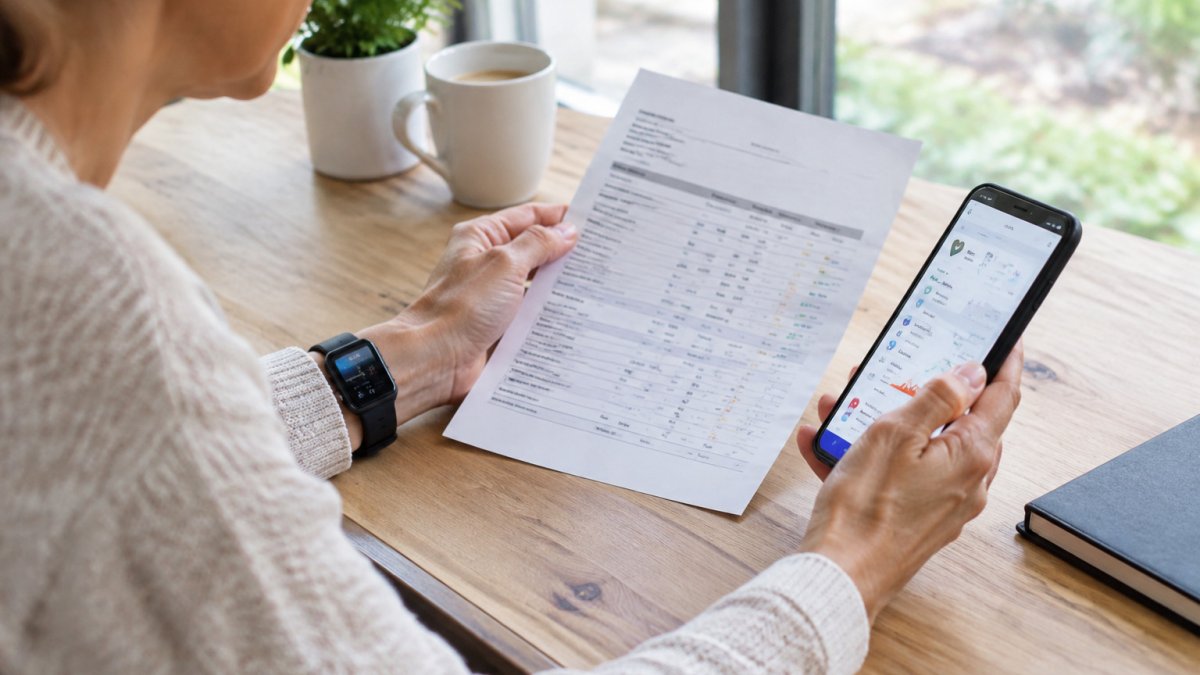
A practical approach:
- Export or copy lab results into one document or dashboard with dates
- Pull weekly averages from your wearable for sleep, heart rate, and activity
- Add mood and stress notes on the same timeline
- Review monthly to spot patterns across all three sources
eeMeds unifies data from wearables, labs, medications, mood, sleep, stress, activity, metabolic health, goals, and routines to show how these inputs interact. It works with the tools you already use rather than replacing them.
For a step-by-step walkthrough, see our guide on combining lab results with wearables: a how-to guide. You can also learn how to analyze lab results with a step-by-step guide before merging them with daily data. To bring your wearable data into one place, read how to integrate wearable health data: a 2026 guide.
Metabolic Health Tracking: Setting Baselines and Spotting Trends
Metabolic health covers how the body handles energy, including blood sugar, lipids, weight, and blood pressure. Tracking it well starts with a baseline.
A baseline is your normal range over a period of stable routine, often two to four weeks. Record resting heart rate, sleep, activity, and any available lab values during that time so future changes are easier to judge.
Once a baseline exists, watch for trends:
- A sustained rise in resting heart rate over two or more weeks
- Sleep that falls below your usual range for several nights
- Lab values that move in the same direction as daily signals
Trends matter more than single days. A bad night is normal. A week of poor sleep alongside rising stress is worth noting.
People using GLP-1 or other weight-management medications may find it useful to discuss tracked trends with their prescribing clinician rather than adjusting treatment on their own.
Privacy, Limits of AI Insights and When to Involve a Clinician
Health data is personal, and connected monitoring multiplies the places it can live. A wearable syncs to a phone, the phone to an app, the app to a dashboard, and the dashboard may share with a clinician. Each hop is a place where data can be exposed, so privacy deserves the same attention as the measurements themselves.
Practical safeguards before you connect anything
Before linking a device or platform, read its privacy policy and check four things: what data is collected, where it is stored, who can access it, and how you can delete it. Prefer platforms that let you export data in a standard format. Use a unique password, turn on two-factor authentication, review app permissions, and revoke access for devices you no longer use.
Consent matters beyond the first sign-up. If you share monitoring records with a clinician, ask how those records are stored and who inside the practice can see them. If you use a platform that pools data for research, check whether participation is opt-in and whether you can withdraw later. These are the same questions you would ask before sharing any sensitive record.
What AI insights can and cannot do
AI can spot patterns quickly across large amounts of data, which is genuinely useful for surfacing trends a person might miss. But an algorithm sees only the data it receives.
A common pattern is that AI tools are most helpful when they summarize trends and least helpful when they label a cause. Treat a summary as a question to bring to a clinician, not as an answer.
Share your record with a clinician effectively
Bringing monitoring data to an appointment is more useful when organized. A short summary beats a raw export: list your main metrics with baseline and recent trend, note lab dates and values, and flag the two or three changes that concern you most.
Distinguish self-monitoring from diagnosis and treatment. Your data can show that something changed; only a clinician can determine why and what to do about it. Never adjust a prescription or treatment plan based on an app reading alone.
When to involve a clinician
Involve a clinician when:
- A reading stays outside the normal range across several checks
- You notice new symptoms such as chest pain, shortness of breath, or fainting
- Lab results change in a way you do not understand
Emergency symptoms need immediate medical care, not an app check. Licensed telehealth can offer a convenient next step for non-emergency questions. eeTeleHealth Plus connects users with licensed professionals for virtual consultations.
Booking Your First Review of Your Health Data
A first review is the easiest way to see how a holistic approach fits your situation. Bring your recent lab results, a few weeks of wearable data, and notes on sleep, mood, and medications.
With eeMeds, your data can be reviewed with a view to a next step, which may be a simple lifestyle change or a conversation with a qualified professional. Visit the eeMeds service page to see how a first review works and what it covers.
Ready to see the whole picture? Then explore how eeMeds connects clinician-guided care with your daily metrics to decide whether a review is right for you.
Frequently Asked Questions
What are the five pillars of holistic health?
Holistic health is usually described through physical, mental, emotional, social and spiritual dimensions. Each one can be tracked in a different way: physical through activity, sleep and heart rate; mental and emotional through mood and stress journals; social through relationships and routines. A holistic monitoring plan works best when it records at least one measure from each area, so a change in one pillar can be compared against the others over time rather than read in isolation.
How can lab results and daily health data be interpreted together?
Lab results give a snapshot taken at one point in time, while wearable and daily logs show patterns across weeks. Read them together by noting the date of each lab test, then checking what your sleep, activity, stress and weight data looked like in the preceding weeks. Look for consistent relationships rather than single readings. Bring these combined trends to a qualified clinician, who can judge what they mean for you individually.
Which health metrics are useful to track over time?
Useful long-term metrics include resting heart rate, sleep duration and consistency, daily activity, body weight and waist measurements, blood pressure where prescribed, and self-rated mood or stress. Track a small set consistently instead of many occasionally. Trends over several weeks are generally more informative than day-to-day fluctuations, and a clinician can help you decide which measures are relevant to your situation.
How often should you review your health metrics with a healthcare professional?
The right schedule depends on your health conditions, medications and the advice of your clinician. Many people with ongoing conditions review their data at each scheduled appointment, and sooner if readings move outside the range your clinician has agreed with you. Wearable and app data is not a substitute for medical assessment, so contact a healthcare professional promptly about any concerning symptoms rather than waiting for the next review.
Taking the next step is simpler when your data works together. eeMeds brings wearables, labs, and daily habits into one view, so you can spot trends early and act on them. Book a first review through eeMeds to understand your health data and decide what to do next.