 Ultimate guide
Managing Chronic Conditions With AI: A Practical Guide
Quick Summary
Managing chronic conditions with AI means using software to combine the health data you already collect, such as readings from wearables, glucose meters and blood pressure cuffs, into patterns you can act on. Because conditions like diabetes and hypertension change slowly, these connected trends help you spot shifts early and prepare better questions for your clinician.
- Chronic conditions unfold over months, so trends matter more than any single reading.
- Connecting wearables, labs, sleep, stress and medication data reveals relationships a single device rarely shows.
- Review alert thresholds with your care team rather than leaving default settings in place.
- Treat AI insights as prompts for better questions, not as a diagnosis.
- Check how your data is shared and whether you can withdraw access to each source.
Table of Contents
- How AI Fits Into Chronic Condition Care Today
- AI Applications for Chronic Condition Self-Management
- Biometric Data Interpretation for Health: Turning Numbers Into Understanding
- Early Detection, Predictive Analytics and Personalized Plans
- AI-Powered Virtual Health Consultations and Where They Fit
- Privacy, Consent, Bias and Electronic Record Integration
- Your Next Step: Bringing Your Data and Your Clinician Together
- Frequently Asked Questions
How AI Fits Into Chronic Condition Care Today
Last Updated: November 4, 2026
Managing chronic conditions with AI is becoming a practical option for people who already live with diabetes, heart disease, hypertension or chronic pain. The core idea is simple: AI takes the steady stream of health data you already generate and turns it into something you can act on.
Chronic conditions are hard to manage because they unfold over months and years. A blood pressure reading on Tuesday means little on its own. The same reading, seen alongside your sleep, stress and medication timing, can reveal a pattern worth discussing with your clinician. That is the gap AI is designed to close.
Most people with a chronic condition already track something. Many use a wearable, a glucose meter or a blood pressure cuff, and several health apps. The problem is fragmentation. Each tool sees one slice of your health, and none of them talks to the others. eeMeds unifies data from wearables, labs, medications, mood, sleep, stress and activity, so the relationships between those inputs become visible.
Here is where the practical value shows up:
- Pattern recognition across sources. Connecting data from wearables, labs, sleep, stress and medications can make relationships between them visible, something a single device rarely reveals.
- Less data overload. Instead of reviewing dozens of charts, you see the few changes that matter.
- Context for conversations. A summary of trends gives you and your clinician a clearer starting point at each appointment.
A common mistake is treating AI output as a diagnosis. It is better understood as a prompt for better questions. The insight tells you where to look; a qualified professional decides what it means for your treatment.
AI Applications for Chronic Condition Self-Management
Self-management is where most of the day-to-day work of a chronic condition happens, and it is where AI tools can help most consistently. The goal is not to replace your care plan but to make it easier to follow between appointments.
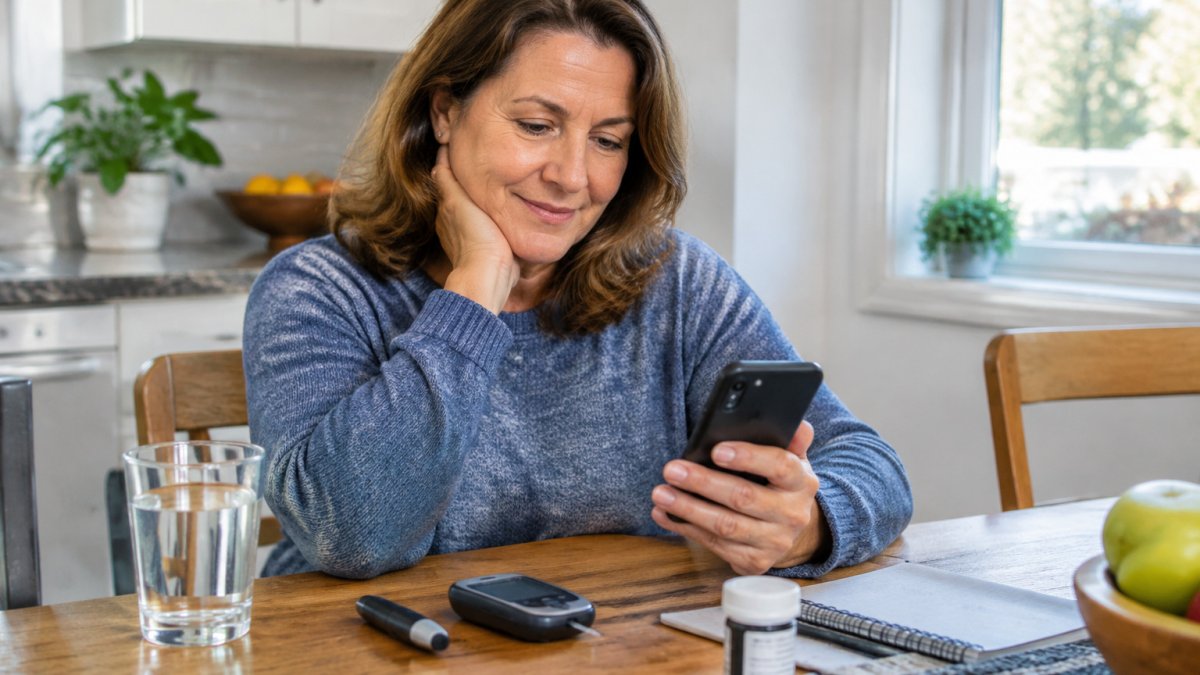
Effective self-management usually depends on three things: knowing what to do, remembering to do it, and noticing when something changes. AI supports all three by reminding you of medication timing, summarizing trends so changes stand out early, and presenting information in plain language rather than raw numbers.
Symptom and Side Effect Tracking
Keeping a symptom diary is recommended by many clinicians, yet it is easy to abandon. AI-assisted tracking lowers the effort by prompting short check-ins and linking symptoms to other data, such as sleep quality or medication changes. This matters most for side effects, which often appear gradually and are easy to dismiss. A pattern of fatigue that begins a week after a dose change is far easier to spot when the data is already connected.
Remote Monitoring and Automated Alerts
Remote monitoring means your readings reach your care team without a clinic visit. Automated alerts can notify you, or your clinician, when a value moves outside a range that has been agreed in advance. The benefit is earlier awareness. The limitation is that alerts are only as good as the thresholds set for them, so these should be reviewed with your care team rather than left at default settings.
The article describes several self-management functions AI supports, summarised below.
| Function | What it does | Key limitation |
|---|---|---|
| Symptom tracking | Prompts short check-ins and links symptoms to sleep or medication changes | Gradual side effects are easy to dismiss without linked data |
| Remote monitoring | Sends readings to your care team without a clinic visit | Alerts are only as good as the agreed thresholds |
| Automated alerts | Notifies you or your clinician when values leave an agreed range | Default settings may not suit you |
Biometric Data Interpretation for Health: Turning Numbers Into Understanding
Raw biometric data, such as heart rate variability, resting heart rate, blood glucose or sleep duration, is only useful once it is interpreted. A single number rarely tells the whole story, and the same value can mean different things for different people.
Interpretation works best when numbers are read as trends and in relation to each other. A resting heart rate that rises slowly over two weeks, alongside shorter sleep and higher reported stress, tells a more useful story than one unusual reading.
Interpreting data is not the same as diagnosing. Biometric insights can point to a change worth discussing with your clinician, but they cannot confirm a condition. Treat the output as a conversation starter, and bring the trend, not just the latest reading, to your next appointment.
Early Detection, Predictive Analytics and Personalized Plans
Predictive analytics uses historical health data to estimate what is likely to happen next. In chronic care, that usually means one of three things: flagging a rising risk of a flare-up, detecting a drop in medication adherence before it shows up in lab results, or spotting a slow worsening trend weeks before it becomes an emergency.
What separates a useful prediction from a noisy alert is the input data and the time window. Most clinical predictive models draw on a combination of structured data (glucose readings, blood pressure, heart rate, weight, lab values, medication fill records) and patient-reported data (symptoms, sleep, stress, activity).
Personalization is what makes those predictions actionable. A generic recommendation to "exercise more" rarely changes behavior. A plan built around your own patterns, such as which days you tend to skip activity and what usually gets you back on track, is far more likely to be followed.
A practical way to use predictive insights without over-relying on them:
- Ask what the prediction is based on. A useful tool should be able to tell you which inputs drove the alert, such as a change in sleep, a missed refill, or a shift in activity.
- Check the time window. A prediction about the next two weeks is more actionable than a vague long-term risk score, and it is easier to discuss with your clinician.
- Review thresholds with your care team. Default alert settings are rarely right for everyone; a clinician can adjust them to your baseline.
- Treat predictions as preparation, not diagnosis. They help you ask better questions and adjust routines; they do not replace clinical judgment.
Watch out: predictions reflect the data available, and they can be wrong when life changes suddenly, such as during an infection, a travel week, or a medication change. A prediction that conflicts with how you feel is a reason to talk to your clinician, not a reason to ignore your symptoms.
For clinicians, the practical value of predictive analytics depends on workflow fit. A risk score that lives in a separate dashboard and never reaches the EHR is easy to ignore.
AI-Powered Virtual Health Consultations and Where They Fit
Virtual consultations give you a way to bring AI-generated insights to a licensed professional without travelling to a clinic. For many chronic conditions, a short video or phone review of recent trends is enough to adjust a plan, while in-person examination remains necessary for other decisions.
This is where eeTeleHealth Plus fits into the picture. eeTeleHealth Plus connects you with licensed professionals for virtual consultations. Virtual care works best as a complement to your existing physician relationship rather than a replacement for it, particularly for conditions that need regular hands-on assessment.
Pricing depends on quantity, dates and delivery, so check the eeMeds website for current details and a quote before booking.
Privacy, Consent, Bias and Electronic Record Integration
Any system that handles health data raises legitimate questions. Who can see your information? Did you agree to its use? Does the system work equally well for everyone?
Privacy starts with consent, and consent should be specific rather than blanket. You should know exactly which data sources are connected, what is shared with whom, and how you can withdraw permission.
Bias is a second concern, and it is not abstract. AI models trained mainly on data from one population can produce less accurate insights for others, particularly when the training data underrepresents older adults, rural patients, or groups with limited access to care.
Integration with electronic health records is the third consideration, and it is where practical implementation usually gets decided. Connecting your wellness data to your clinical record can improve continuity of care, but it should be a choice you make deliberately.
A short checklist before you connect anything:
- Confirm the data path. Ask which systems receive your data, whether the clinician actually reviews it, and how often.
- Check withdrawal. Make sure you can revoke access to a data source without cancelling the whole service.
- Ask about validation. Request a plain-language answer on how the models were tested across different patient groups.
- Review storage and access. Understand who inside the organization can see your data and under what circumstances.
Watch out: a tool that asks for broad access to your device or account may collect more than the condition requires. Grant the narrowest access that still makes the service work, and revisit those permissions periodically.
Health equity belongs in this conversation too. AI can either widen disparities, if it is deployed only where infrastructure already exists, or narrow them, if it is used to extend monitoring and follow-up to patients who struggle to attend in-person visits.
Your Next Step: Bringing Your Data and Your Clinician Together
The most useful next step is simple: choose one or two data sources that matter most for your condition, review the trends for a few weeks, and bring what you notice to your next appointment. AI helps you see patterns, but the decisions about your care belong in a conversation with your clinician.
eeMeds helps you see the whole person by connecting your wearable, your journal and your lab results in one place. Learn more on the eeMeds website.
Frequently Asked Questions
How can artificial intelligence be used to manage chronic diseases?
AI can combine data from wearables, lab results, medication logs and symptom diaries to spot patterns that are easy to miss day to day, such as sleep disruption preceding a flare or stress tracking alongside blood pressure changes. It can then prompt a self-management step or flag a trend for review by a clinician. It works best as a supplement to care plans your doctor already manages, not a replacement for them. Results depend on data quality and on the condition being tracked, so treat AI insights as prompts for conversation with a qualified professional rather than as diagnoses.
How does AI help in interpreting personal biometric health data?
Biometric data from devices like smartwatches and rings is often shown as isolated numbers. AI tools can place those numbers in context by comparing them with your own baseline, your sleep, activity and stress records, and your medication timing. This helps explain why a metric changed rather than only that it changed. Interpretation is general information, not medical advice, so bring notable patterns to your clinician. Accuracy varies by device and sensor, so check how your specific device measures each metric.
What role does virtual care play alongside AI in chronic condition management?
Virtual care gives you access to licensed professionals without travelling to a clinic, which matters when a condition needs regular check-ins. AI-generated insights can make those consultations more focused, since you arrive with patterns rather than memories. Virtual care suits many routine reviews and medication questions, but it cannot replace in-person examination when one is needed. Availability, scope of service and pricing depend on the provider, so check eeMeds's website for current details and a quote.
Is AI-powered health monitoring safe for chronic disease patients?
AI monitoring carries real limits. Sensor readings can be affected by movement, skin contact and device settings, and algorithms can perform less well for some groups if the data used to train them was not diverse. Privacy and consent over your health data also deserve attention before you connect any platform. Use AI monitoring to support, not override, the instructions your care team gives you, and report any worrying symptom directly to a clinician instead of waiting for an automated insight.