 blog
7 Wellness App Features That Turn Data Into Action
Last Updated: October 30, 2026
Quick Summary
A wellness app with actionable insights turns your data into a specific, testable next step instead of just showing scores. Look for one that captures wearables, labs, mood and medications, then translates patterns into changes you can measure and recheck. If it only explains what a number is, not what moved it, it is still a tracker.
- A real insight moves data through four stages: capture, normalize, correlate, and translate.
- Spend your trial period testing the translation stage, where patterns become next steps.
- Score any recommendation on specificity, traceability, proportionality, honesty about limits, and evidence basis.
- Legitimate tools frame suggestions as experiments with a recheck point, not guarantees.
- If an app fails the insight test or the care-path test, keep looking.
Table of Contents
- Why Most Wellness Apps Leave You With Numbers, Not Answers
- How to Make Sense of Health Metrics Without a Medical Degree
- Health Apps With Personalized Insights: What Separates Useful From Generic
- Wellness App Features Comparison: What to Check Before You Commit
- Personalized Wellness Recommendations: How to Judge Whether They're Reliable
- Privacy, Consent, and Health Data: Questions to Ask Before Syncing
- When an App Isn't Enough: Connecting Insights to Real Care
- Choosing Your Wellness App: A Five-Minute Decision Framework
- Frequently Asked Questions
Why Most Wellness Apps Leave You With Numbers, Not Answers
A wellness app with actionable insights should tell you what to do next, not just hand you a dashboard. Most don't.
The pattern is predictable. You buy a wearable, sync three apps to your phone, and within a month you have more data than you had before and no clearer idea what to change.
Below, we break down seven features that separate apps which actually guide you from apps that just count things. Each one is something you can check for yourself before you commit to a subscription.
How to Make Sense of Health Metrics Without a Medical Degree
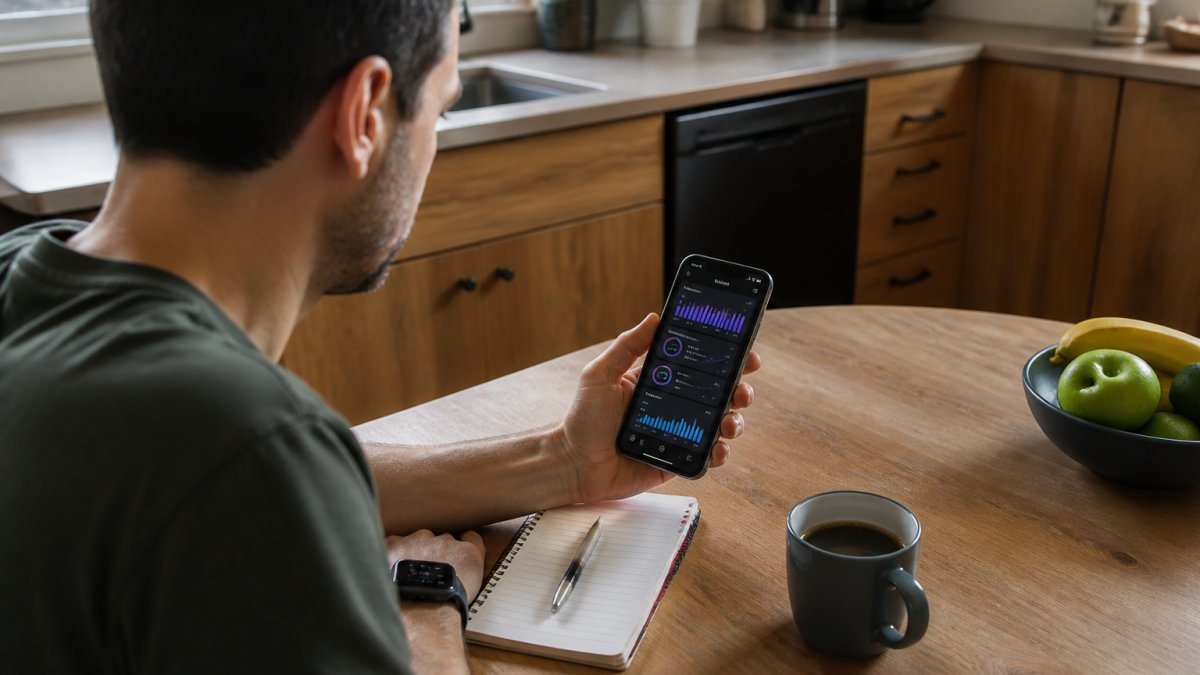
Start with three questions for any metric on your screen. What is this measuring, what moved it, and what would change it? If the app cannot answer all three, the number is decoration.
The Three Questions Every Metric Should Answer
Take resting heart rate. A useful app explains what a metric measures and what might have moved it, rather than only showing the number.
Health Apps With Personalized Insights: What Separates Useful From Generic
Personalized guidance is only as good as the inputs behind it. An app that sees your sleep but not your stress, or your steps but not your lab results, is guessing at cause. But inputs alone don't create insight, the transformation from raw data to a next step is where most apps fall short, and it's the part worth inspecting before you subscribe.
The Four-Stage Pipeline Behind a Real Insight
A wellness app with actionable insights generally moves your data through four stages. You can test any app against them.
- Capture. Wearables, manual logs, labs, medications, mood check-ins, and routines are collected. The question here is coverage: does the app see one silo or several? A sleep-only app cannot tell whether a bad night was driven by stress, a late meal, or a new medication.
- Normalize. Different devices report the same signal differently, one watch's "readiness" is not another's. A useful app aligns timestamps, units, and baselines so a comparison is meaningful. If the app can't reconcile two sources, it will either double-count or ignore one.
- Correlate. This is where patterns emerge: resting heart rate rising across the same three days your mood log dips, or step counts falling in the week after a schedule change. Correlation is not causation, and a good app says so, but it is the raw material of a personalized insight.
- Translate. The final step turns a pattern into a specific, testable next step: "Shift bedtime 30 minutes earlier for two weeks and recheck," not "improve sleep hygiene." This is the stage most apps skip, and it is the one the keyword is really about.
A common mistake is assuming more data automatically means better insight. It doesn't. Context does. An app that knows you started a new medication last month can read a shift in your sleep differently than one that only sees the sleep graph.
What to Look For in the Translation Stage
When you evaluate an app, spend your trial period on stage four. Ask:
- Does the insight name the pattern it came from ("your resting heart rate rose on the three nights your mood log dropped")?
- Does it propose a change you can actually make and measure?
- Does it tell you when to recheck, and what would count as improvement?
An app that can answer all four is doing the work the keyword promises. One that only answers the first is still a tracker with better marketing.
This is where eeMeds fits in. The platform unifies data from wearables, labs, medications, mood, sleep, stress, activity and routines, and uses Behavioral Driver Analysis™ to add personal context behind the patterns. It works as an intelligence layer over the apps and devices you already use.
Wellness App Features Comparison: What to Check Before You Commit
Judge a wellness app on what it does with your data, not how much it collects. The table below is the checklist we would use ourselves.
Feature Table: What Matters and Why
| Feature | What to Look For | Why It Matters |
|---|---|---|
| Data integration | Syncs wearables, labs, mood, meds | Fragmented data hides causes |
| Insight quality | Explains the "why," not just the "what" | Numbers without context stall action |
| Recommendation basis | Cites your own patterns | Generic tips ignore your situation |
| Privacy controls | Clear consent and export options | Health data is sensitive by default |
| Human escalation | Path to a licensed professional | Some findings need real care |
| Accessibility | Readable, adjustable interface | Insight you can't use isn't insight |
Before committing, check how the app turns your data into a next step. See how eeMeds does it with AI-supported insights and a human-guided pathway.
Personalized Wellness Recommendations: How to Judge Whether They're Reliable
A reliable recommendation is specific, traceable, and modest. It points to the pattern it came from and stops short of diagnosing you. That much is easy to say. The harder question, and the one most app roundups skip, is how to score a recommendation you're looking at right now, before you've paid for a year of it.
A Five-Point Scorecard You Can Run in Two Minutes
Take any personalized suggestion the app gives you and rate it on five dimensions. Each is a yes/no question; a strong recommendation scores four or five.
| Dimension | The Question to Ask | Weak Example | Strong Example |
|---|---|---|---|
| Specificity | Does it name a concrete action and a timeframe? | "Improve sleep hygiene" | "Shift bedtime 30 minutes earlier for two weeks and recheck" |
| Traceability | Does it show which data points drove it? | "Based on your profile" | "Your resting heart rate rose on the three nights your mood log dropped" |
| Proportionality | Is the suggested change small enough to test safely? | "Cut all caffeine immediately" | "Try decaf after 2 p.m. for one week" |
| Honesty about limits | Does it say when a pattern needs a professional? | Silent on escalation | "If this persists past two weeks, consider a clinician" |
| Evidence basis | Does it rest on established guidance rather than a single data point? | One night's reading | A pattern across multiple nights, consistent with common sleep-hygiene guidance |
Run this on three recommendations from any app and you'll have a clearer picture of its insight quality than any feature list will give you.
Evidence-Informed vs. Generic: How to Tell the Difference
Most wellness apps fall into one of three tiers, and the tier matters more than the feature count.
- Generic tips. The same advice for every user, drink water, walk more, sleep eight hours. Useful as a starting point, but not personalized, and not what the keyword promises.
- Pattern-based suggestions. The app notices a correlation in your own data and proposes a change. Better, but the quality depends entirely on whether the pattern is real or noise. A single bad night is not a pattern; a consistent shift across a week or more is more credible.
- Evidence-informed, pattern-based guidance. Some apps combine your patterns with established public-health guidance and frame suggestions as tests rather than verdicts. This is the tier to look for.
A useful rule of thumb: the more confident the app sounds, the more you should ask what it's basing that confidence on. Wellness tools can flag patterns; they cannot confirm a condition. A recommendation that presents itself as medical advice without a clinician behind it is a red flag, not a feature.
Privacy, Consent, and Health Data: Questions to Ask Before Syncing
Health data is among the most sensitive information you will ever hand to an app. Treat the sync screen as a contract, not a formality.
Questions worth asking before you connect a device:
- What exactly is collected, and can I limit it?
- Can I export or delete my data on request (Information for individuals)?
- Who can see it, and is it shared with third parties?
For a practical walkthrough, our guide on how to keep your health data secure covers the settings and habits that matter most.
When an App Isn't Enough: Connecting Insights to Real Care
Some patterns need a person, not a dashboard. Persistent sleep disruption, mood changes, or metabolic shifts deserve a licensed professional's eyes.
An app's job is to get you to that conversation better prepared.
That handoff is where eeTeleHealth Plus™ fits. It connects you with licensed professionals for virtual consultations, so an insight can turn into an actual care decision instead of another graph.
Choosing Your Wellness App: A Five-Minute Decision Framework
Run any app through this sequence before you pay for it:
- List your inputs. Wearable, labs, mood, medications, routines.
- Check integration. Does the app see all of them, or just one?
- Test one insight. Does it explain the cause, or only the number?
- Read the privacy terms. Can you export and delete your data?
- Confirm the care path. Is there a route to a licensed professional?
If an app fails step three or step five, keep looking. Those two decide whether you get guidance or just another scoreboard.
If you want to understand the mechanics behind personalized insight, our guide to behavioral driver analysis explains how patterns become recommendations.
Frequently Asked Questions
What is a wellness app with actionable insights?
It is a wellness app that goes past logging and displays. Instead of only showing a sleep score or a step count, it explains what the pattern likely means and suggests a specific next step, such as shifting bedtime earlier or adding a short walk after lunch. The useful test is simple: after opening the app, can you name one thing you will do differently today? If the answer is no, you are looking at a dashboard, not an insight tool. Look for apps that connect data across sleep, stress, activity and mood rather than reporting each in isolation.
Which health apps with personalized insights actually turn data into practical recommendations?
The ones that combine several data sources before making a suggestion. A recommendation built only on step count is thin; one built on sleep, stress, activity and medication timing has context. Ask three things: does the app explain why it made the suggestion, does it show the data behind it, and can you trace the recommendation back to something you can change this week? Platforms such as eeMeds unify wearables, labs, mood and medication data, and offer a human-guided pathway for discussing next steps.
How accurate are insights from a wellness app, and can I rely on them?
Treat them as informed observations, not diagnoses. Consumer wearables measure heart rate and movement reasonably well but estimate sleep stages and stress with more error, so an app's conclusions inherit that uncertainty. A good app states its confidence, shows the underlying data, and avoids absolute claims. Use insights to spot patterns worth discussing, such as a consistent dip in recovery after late meals, and bring them to a clinician for interpretation. No app should tell you to stop or change a prescribed medication, and any recommendation that does is a warning sign.
Can a wellness app connect me with a healthcare professional?
Some do, and the difference matters. A referral link or a chatbot is not the same as access to licensed clinicians. Check who you actually reach, how quickly, and whether they can review your tracked data during the consultation. eeMeds pairs its insight platform with eeTeleHealth Plus, which connects users to licensed professionals for virtual consultations, Confirm availability and scope in your region before relying on it for anything urgent.
The real test of a wellness app is simple: after a week, do you know what to change? If the answer is no, the app is tracking you without helping you. eeMeds was built to close that gap, with device-neutral integration, Behavioral Driver Analysis™ that adds context to your patterns, and a direct pathway to licensed care through eeTeleHealth Plus™. Get started with eeMeds and turn your health data into your next clear step.